Psyllium guide
Psyllium for cholesterol: dose, timing and cost
A meta-analysis of 28 trials found about 10 g of psyllium a day lowered LDL by roughly 13 mg/dL. The dose, medication spacing, and what it costs per day.
Psyllium is one of the few supplements with an FDA-authorized heart health claim. It is also cheap. Here is what it can realistically do for cholesterol, how much to take, and what that dose costs.
How much it lowers cholesterol
The best summary is a 2018 meta-analysis in The American Journal of Clinical Nutrition by Jovanovski and colleagues. It pooled 28 randomized trials with 1,924 people, with and without high cholesterol. Every trial lasted at least 3 weeks.
At a median dose of about 10.2 g of psyllium a day, the results were:
- LDL cholesterol fell by about 0.33 mmol/L, roughly 13 mg/dL.
- Non-HDL cholesterol fell by about 0.39 mmol/L, roughly 15 mg/dL.
- Apolipoprotein B fell by about 0.05 g/L.
The authors rated the LDL evidence moderate quality, downgraded because results varied between trials. That variation is real. A 2004 crossover trial in people with normal or slightly high cholesterol found no cholesterol lowering at all. So expect a modest average effect, and expect it to differ from person to person.
A modest drop can still be worth having. It is smaller than what a statin does, and it is not a reason to change a prescription on your own.
How it works
Psyllium's soluble fiber forms a thick gel in the gut. The leading explanation is that this gel binds bile acids and carries them out in stool. The liver makes new bile acids from cholesterol, so it pulls more LDL from the blood to keep up.
That is why the fiber line on the label matters, not the weight of the powder.
How much to take
| Amount | |
|---|---|
| FDA health claim | 7 g of soluble fiber from psyllium husk a day |
| Per serving, for the claim | at least 1.7 g of soluble fiber |
| Meta-analysis median | about 10 g of psyllium a day |
| Typical label serving | about 3 to 7 g of fiber |
Approximate figures. Check your product's panel.
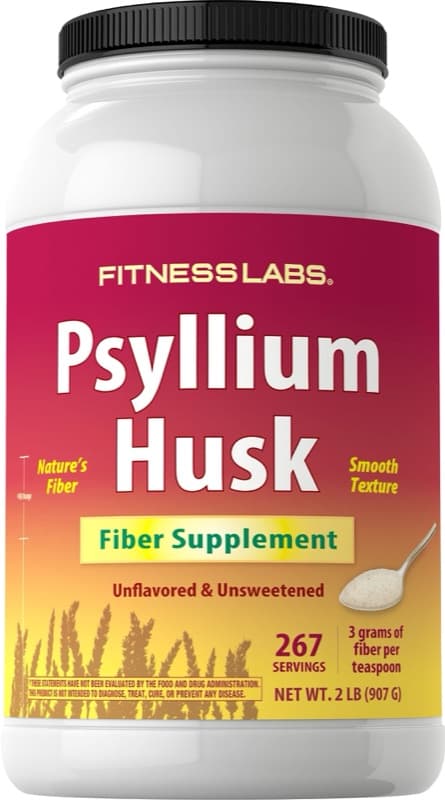
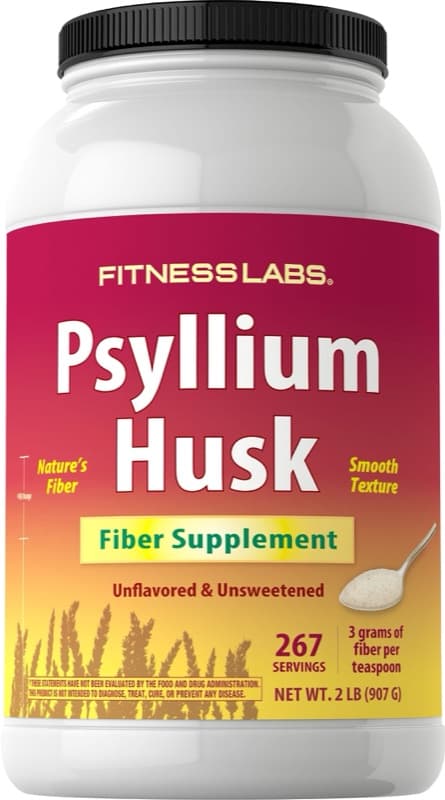
Psyllium husk is mostly fiber, and much of that fiber is soluble. Plain husk labels on our list state about 3 g of fiber per 3.4 g serving, or 4 g of fiber per 5 g scoop. So 10 g of husk is roughly 8 to 9 g of fiber. If your label lists soluble fiber separately, add it up across the day to see how close you are to 7 g.
Most people reach that by taking one serving two or three times a day. Our guide to reading a Supplement Facts label covers where the fiber line sits.
Does timing matter?
Less than you might think. The 2004 crossover trial tested psyllium with breakfast against psyllium at bedtime, on the theory that morning doses would bind more bile. Timing made no difference. Pick the time you will stick with.
The timing that does matter is around medicines. Psyllium can change how some drugs are absorbed. MedlinePlus says not to take digoxin, aspirin or nitrofurantoin within 3 hours of psyllium. Ask your pharmacist how far apart to space your own medicines.
How to take it safely
- Mix each dose with at least 8 oz (240 mL) of water or other liquid and drink it right away. FDA-required labels warn that psyllium taken without enough liquid can swell and cause choking.
- Do not take it if you have trouble swallowing.
- Start with one serving a day and build up over a couple of weeks to limit gas and bloating. More on that in Metamucil vs generic psyllium.
- Tell your doctor and pharmacist before you start, especially if you take prescription medicine or have had intestinal blockage, kidney disease, diabetes or heart disease.
What it costs per day
Our psyllium list prices every product per 5 g of fiber, the dose basis that keeps powders and capsules comparable.
As of October 8, 2026, plain powders on the list ran about 18 to 38 cents per 5 g of fiber. At roughly 9 g of fiber a day, that is about 32 to 68 cents a day. The cheapest powder works out to about $9.50 a month.
Capsules cost far more for this use. The one capsule row on our list was about 66 cents per 5 g of fiber, and its label puts 1 g of fiber in 3 capsules. Reaching 9 g of fiber would take about 27 capsules a day, at around $1.18.
| Product | Store | Per 5 g fiber | vs Metamucil |
|---|---|---|---|
| Piping Rock Psyllium Husks · 2 lb Bottle | Piping Rock | $0.17 | 46% less |
| Micro Ingredients Organic Psyllium Husk Powder, Unflavored · 2 Pounds | Micro Ingredients | $0.20 | 38% less |
| NOW Foods Whole Psyllium Husks · 24 oz | Vitacost | $0.20 | 38% less |
| Viva Naturals Organic Psyllium Husk Powder · 24 oz | Vitacost | $0.21 | 34% less |
| PureBulk Psyllium Husk Powder · 1 kilogram | PureBulk | $0.28 | 14% less |
| Metamucil Sugar-Free Orange Smooth Fiber Powder · 36.8 oz popular brand | Target | $0.32 | — |
Prices checked November 7, 2026. Store prices change; the price at checkout is final. See the full psyllium list
The table shows today's cheapest rows per 5 g of fiber. Metamucil and generic psyllium husk contain the same fiber. What you pay for is flavor, sweetener and texture, which is why plain powder usually costs the least per gram of fiber.
Frequently asked questions
How much psyllium lowers cholesterol?
Trials pooled in a 2018 meta-analysis used a median of about 10 g of psyllium a day and found LDL fell by about 13 mg/dL. The FDA health claim is based on 7 g of soluble fiber from psyllium husk a day.
How long does psyllium take to lower cholesterol?
Every trial in the 2018 meta-analysis lasted at least 3 weeks. Ask your doctor when a follow-up cholesterol test makes sense.
Can psyllium replace statins?
No. Its average effect is much smaller. Do not stop or change prescribed medication without talking to your doctor.
When should I take psyllium for cholesterol?
A crossover trial found no difference between taking it with breakfast and at bedtime. Space it away from other medicines, and take each dose with at least 8 oz of liquid.
Are psyllium capsules as good as powder for cholesterol?
The fiber is the same, but one capsule product on our list needs 3 capsules for 1 g of fiber. A cholesterol-level dose would take more than 25 capsules a day, which costs much more than powder.
Sources
- Effect of psyllium fiber on LDL cholesterol, non-HDL cholesterol and apoB: meta-analysis of randomized trials (Jovanovski et al., Am J Clin Nutr, 2018) (opens in a new tab)
- Effect of time of administration on cholesterol lowering by psyllium: randomized crossover study (Van Rosendaal et al., Nutrition Journal, 2004) (opens in a new tab)
- FDA health claim: soluble fiber from psyllium husk and coronary heart disease (21 CFR 101.81) (opens in a new tab)
- FDA labeling warning for psyllium and other bulk laxatives (21 CFR 201.319) (opens in a new tab)
- MedlinePlus: Psyllium drug information (opens in a new tab)
Every price on the list is worked out the same way, and checked daily.
See the psyllium price comparisonCheaper alternatives to Metamucil psylliumMetamucil vs Piping Rock psylliumMetamucil vs NOW Foods psyllium
This is general information about prices and labels, not medical advice. Ask a doctor or pharmacist before starting a supplement, especially if you are pregnant, take medication, or have a health condition. These statements have not been evaluated by the Food and Drug Administration, and no supplement here is intended to diagnose, treat, cure, or prevent any disease. We don't sell the products; how we make money.