Glutathione guide
Oral glutathione: what studies found and cost per 500 mg
Whether glutathione pills raise glutathione levels, what the trials of plain and liposomal forms found, and what reduced glutathione costs per 500 mg today.
Glutathione is a small molecule your body makes from three amino acids: glutamate, cysteine and glycine. It is one of the body's main antioxidants, and supplements are sold for "antioxidant support", skin and aging. This guide covers what the human trials measured, where the evidence stops, and what 500 mg costs.
Does oral glutathione get absorbed?
This is the main question, and the answer has changed over time.
Glutathione is a tripeptide, a chain of three amino acids, and it has been shown to be absorbed in lab animals. Whether it works the same way in people was an open question. In a 2011 trial, Jason Allen and Ryan Bradley gave 40 healthy adults either 500 mg of glutathione twice a day or a placebo for 4 weeks. They found no significant change in glutathione status or in markers of oxidative stress.
A longer trial gave a different result. In 2015, John Richie and colleagues at Penn State ran a 6-month randomized, double-blind, placebo-controlled trial in 54 non-smoking adults, using 250 mg or 1,000 mg a day:
- Glutathione in blood rose at 1, 3 and 6 months at both doses.
- In the 1,000 mg group, levels at 6 months were 30 to 35% higher in red blood cells, plasma and lymphocytes, and 260% higher in cheek cells.
- In the 250 mg group, levels rose 17% in whole blood and 29% in red blood cells.
- Levels went back to baseline one month after people stopped.
So the best trial so far suggests daily oral glutathione can raise body stores over months. It is still one trial of 54 people, and it measured lab markers, not how people felt.
| Study | People | Dose | Length | Result |
|---|---|---|---|---|
| Allen and Bradley, 2011 | 40 healthy adults, placebo-controlled | 500 mg twice a day | 4 weeks | No significant change in glutathione or oxidative stress markers |
| Richie et al., 2015 | 54 non-smoking adults, placebo-controlled | 250 or 1,000 mg a day | 6 months | Higher glutathione levels at both doses; back to baseline 1 month after stopping |
| Sinha et al., 2018 (liposomal) | 12 healthy adults, no placebo group | 500 or 1,000 mg a day | 1 month | Higher glutathione levels after 1 to 2 weeks |
Summarized from the published abstracts.
Is liposomal glutathione better?
Liposomal products wrap glutathione in tiny fat bubbles so that, in theory, more survives digestion. The main human study is a 2018 pilot from the same Penn State group. Twelve healthy adults took 500 or 1,000 mg of liposomal glutathione a day for one month. Blood glutathione rose within a week, with the largest increases after two weeks: about 40% in whole blood and 28% in plasma. Some oxidative stress and immune markers also changed.
What the pilot cannot tell you:
- There was no placebo group, so changes are compared with each person's own starting levels.
- It did not compare liposomal with plain glutathione. It cannot show that liposomal works better or faster.
- Twelve people is very small. The authors called the findings preliminary.
On our list, the liposomal capsules cost several times more per 500 mg than plain reduced glutathione. The research does not yet show what that premium buys.
Does glutathione lighten skin?
Skin lightening is a common reason people search for glutathione. The trials above measured glutathione in blood and cells, not skin tone, so they say nothing about skin.
Injectable glutathione is a separate matter. In 2019 the FDA reported that seven patients at one clinic reacted within minutes of intravenous glutathione, with nausea, vomiting and chills; one went to the hospital. The injection had been compounded from powder labeled as a dietary supplement, and FDA testing found too much bacterial endotoxin in it. The FDA said supplement-grade powder should not be used to make injectable drugs.
Is glutathione safe to take?
The trials above gave healthy adults up to 1,000 mg a day for as long as 6 months, and their abstracts report no safety problems, but they were small. There is no official recommended intake or upper limit, because your body makes glutathione.
Ask a doctor or pharmacist before taking glutathione if you:
- take prescription medication
- are pregnant or breastfeeding
- want to give it to a child
Glutathione supplements are not a treatment for any disease.
What does glutathione cost per 500 mg?
Our glutathione list prices every product per 500 mg of reduced L-glutathione. That matches the dose in most capsules and sits between the two doses in the 2015 trial, but it is a unit for comparing prices, not advice on how much to take. See how it works for the full rules.
| Product | Store | Per 500 mg | vs Thorne |
|---|---|---|---|
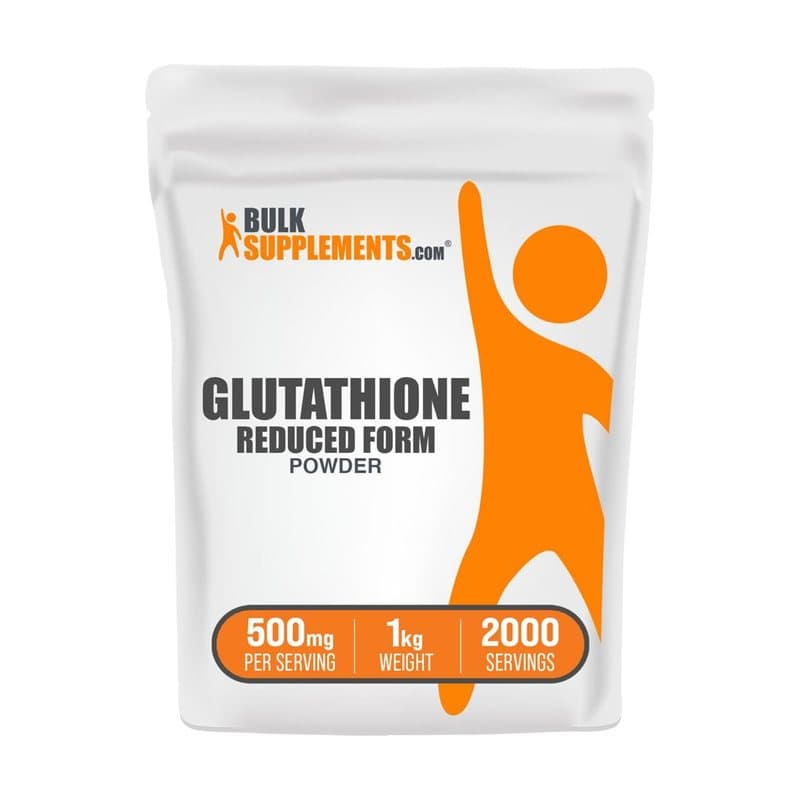
| BulkSupplements Glutathione Powder (Reduced Form) · 1 Kilogram | BulkSupplements | $0.07 | 97% less |
| Nutricost Glutathione Capsules | Nutricost | $0.18 | 93% less |
| Piping Rock L-Glutathione (Reduced) · 500 mg · 50 Quick Release Capsules | Piping Rock | $0.30 | 89% less |
| Healthy Origins L-Glutathione Reduced Setria 500 Mg, by Healthy Origins · 150 Capsules | NHC | $0.33 | 87% less |
| Cardiovascular Research Reduced Glutathione Powder, by Cardiovascular Research · 50 Grams | NHC | $0.48 | 82% less |
| Jarrow Formulas Glutathione Reduced 500 Mg, by Jarrow Formulas · 150 Veg Capsules | NHC | $0.51 | 80% less |
| Thorne Glutathione-SR, by Thorne Research · 60 Veg Capsules popular brand | NHC | $2.62 | — |
Prices checked November 25, 2026. Store prices change; the price at checkout is final. See the full glutathione list
In our November 22, 2026 price check:
- A 1 kg bag of reduced glutathione powder cost about 7 cents per 500 mg.
- The cheapest capsules, a 240-count bottle of 500 mg capsules, cost about 18 cents per 500 mg.
- A 150-count bottle of 500 mg capsules made with Setria, a branded form of reduced glutathione, cost about 33 cents per 500 mg.
- The two liposomal capsules on the list cost roughly $1.33 and $1.67 per 500 mg.
- Thorne's Glutathione-SR, at 175 mg per capsule, cost about $2.62 per 500 mg, the most on the list.
A 60-count bottle of 250 mg capsules holds only 30 servings of 500 mg, so read the milligrams per capsule before comparing bottles; our guide to reading a Supplement Facts label shows where to look.
Prices change daily, and the table above updates on its own. Nothing is ranked by commission, and we don't sell the products. Only reduced L-glutathione qualifies: liquids, blends and S-acetyl glutathione are left off the list, because their dose and price cannot be compared fairly.
Powder or capsules?
Powder is cheapest, but 500 mg is hard to measure without a scale that reads to 0.01 g. Capsules cost more per dose but give a fixed amount every time.
For capsules, a large bottle of plain 500 mg capsules is usually the best value. A third-party seal tells you the label was checked; see what third-party tested means.
Frequently asked questions
Does oral glutathione actually work?
A 6-month trial of 54 adults found that 250 or 1,000 mg a day raised glutathione levels, while a 4-week trial found no change. Neither tested a health or skin outcome.
Is liposomal glutathione better than regular glutathione?
That has not been shown. The main liposomal study had 12 people, no placebo group and no plain glutathione group to compare with. In our November 2026 price check, liposomal capsules cost several times more per 500 mg than plain reduced glutathione.
How much glutathione did studies use?
The placebo-controlled trials used 250 mg to 1,000 mg a day, and the liposomal pilot used 500 or 1,000 mg a day. There is no official recommended intake, so ask a doctor or pharmacist what is right for you.
What is the cheapest way to buy glutathione?
Bulk reduced glutathione powder, at about 7 cents per 500 mg in our November 22, 2026 price check. The cheapest capsules cost about 18 cents per 500 mg.
Sources
- Randomized controlled trial of oral glutathione supplementation on body stores of glutathione (Richie et al., European Journal of Nutrition, 2015) (opens in a new tab)
- Effects of oral glutathione supplementation on systemic oxidative stress biomarkers in human volunteers (Allen and Bradley, 2011) (opens in a new tab)
- Oral supplementation with liposomal glutathione elevates body stores of glutathione and markers of immune function (Sinha et al., European Journal of Clinical Nutrition, 2018) (opens in a new tab)
- FDA highlights concerns with using dietary ingredient glutathione to compound sterile injectables (FDA, 2019) (opens in a new tab)
Every price on the list is worked out the same way, and checked daily.
See the glutathione price comparisonCheaper alternatives to Thorne glutathioneThorne vs Nutricost glutathione
This is general information about prices and labels, not medical advice. Ask a doctor or pharmacist before starting a supplement, especially if you are pregnant, take medication, or have a health condition. These statements have not been evaluated by the Food and Drug Administration, and no supplement here is intended to diagnose, treat, cure, or prevent any disease. We don't sell the products; how we make money.