Taurine guide
Taurine supplement: dose, safety and cost per 2 g
What doses taurine studies used, the 3 g a day safety benchmark, what the anti-aging headlines did and did not show, and what plain taurine costs per 2 g.
Taurine is an amino acid your body makes, best known as an energy drink ingredient and, since 2023, sold as a longevity supplement. This guide covers what the research tested, how much is considered safe, and what 2 g costs.
What dose of taurine did studies use?
There is no official recommended intake for taurine. It is not a vitamin, and the NIH calls it a conditionally essential amino acid. Doses therefore come from research, not from a daily value on the label.
| Source | What it looked at | Taurine dose |
|---|---|---|
| Waldron et al., 2018 meta-analysis | 10 studies of endurance exercise | 1 to 6 g a day, as a single dose or for up to 2 weeks |
| Shao and Hathcock, 2008 risk assessment | Published human trials, for safety | Strong evidence of no adverse effects up to 3 g a day |
| Singh et al., 2023 | Mice, worms, yeast and monkeys | Mice: 500 or 1,000 mg per kg of body weight a day; monkeys: 250 mg per kg a day |
Summarized from the published abstracts and figure legends.
The animal doses are far above what people take: 1,000 mg per kg would be 70 g a day for a 70 kg (154 lb) person.
Our taurine list prices every product per 2 g. That sits inside the range the exercise studies used and under the 3 g safety benchmark, but it is a unit for comparing prices, not advice on how much to take. See how it works for the full rules.
Is taurine safe?
For healthy adults at common supplement doses, the evidence is reassuring. In a 2008 risk assessment, Andrew Shao and John Hathcock reviewed the published human trials and found no consistent pattern of side effects from taurine. Because no harmful dose could be identified, they could not set a standard upper limit. Instead, they set an "observed safe level" of 3 g a day of supplemental taurine for healthy adults.
The authors noted that higher amounts have been tested without adverse effects, but the data above 3 g a day were not enough to be confident about long-term safety.
Ask a doctor or pharmacist before taking taurine if you:
- take prescription medication, including blood pressure drugs
- have kidney or liver disease
- are pregnant or breastfeeding
- want to give it to a child
Does taurine slow aging?
In June 2023, a large study in Science by Singh and colleagues reported that blood taurine fell with age in mice, monkeys and humans. Giving taurine to middle-aged mice extended their lifespan and improved measures of health such as bone, muscle strength and memory. Taurine-fed monkeys also had better health markers after six months. Worms lived longer too.
What the 2023 study did not show:
- It did not test taurine supplements in people. The human data linked lower taurine levels with several age-related diseases. That is an association, not proof that taking taurine helps.
- The monkey work measured health markers, not lifespan.
- The authors themselves wrote that clinical trials in humans are needed to find out whether taurine deficiency drives aging in people.
Then, in June 2025, NIH researchers published a follow-up in Science. They measured taurine in blood collected over years from the same people in the Baltimore Longitudinal Study of Aging (aged 26 to 100), from rhesus monkeys and from mice. Taurine levels went up with age in every group except male mice, where they stayed flat. Differences within one person over time were often larger than the change with age, and taurine levels were not consistently linked to muscle strength or body weight.
The NIH's summary: there is no solid clinical data showing that taurine supplementation benefits humans. The anti-aging case rests on animal studies, and its main human premise, that taurine falls with age, did not hold up in the long-term data.
Does taurine help exercise performance?
There is modest evidence. The 2018 meta-analysis by Waldron and colleagues pooled 10 studies and found that taurine improved endurance performance by a small to moderate amount. Doses from 1 to 6 g worked about equally well, and a single dose did about as well as up to two weeks of daily use.
Ten studies is a small evidence base, and the trials were short lab tests. If you are comparing performance supplements, see also our guides to L-citrulline doses and cost and beta-alanine dose and tingles, which have their own research and their own limits.
Is taurine powder or capsules cheaper?
Powder, by a wide margin. Taurine is a cheap commodity powder, much like glycine. Here are today's lowest prices per 2 g:
| Product | Store | Per 2 g | vs NOW Foods |
|---|---|---|---|
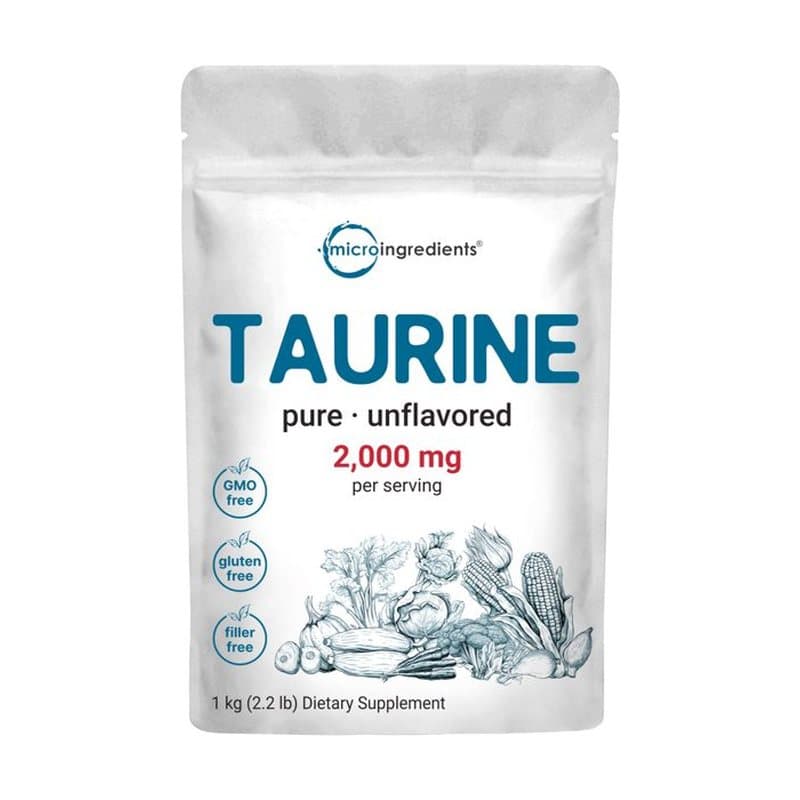
| Micro Ingredients Taurine Powder · 500 Servings | Micro Ingredients | $0.048 | 47% less |
| PureBulk Taurine · 1 kilogram | PureBulk | $0.051 | 43% less |
| Nutricost Taurine Powder · 1 Kilogram | Nutricost | $0.058 | 36% less |
| BulkSupplements Taurine Powder · 1 Kilogram | BulkSupplements | $0.066 | 27% less |
| NOW Foods Taurine Powder · 8 oz popular brand | Vitacost | $0.09 | — |
Prices checked November 25, 2026. Store prices change; the price at checkout is final. See the full taurine list
In our November 21, 2026 price check, 1 kg and 1.5 kg bags of plain taurine powder cost roughly 5 to 7 cents per 2 g. A smaller 8 oz powder cost about 9 cents per 2 g. The capsules on our list cost roughly 21 to 33 cents per 2 g, three to seven times more for the same taurine. A 1 kg bag holds 500 servings of 2 g.
Prices change daily, and the table above updates on its own. Nothing is ranked by commission, and we don't sell the products. Only plain taurine qualifies: energy drinks, pre-workout blends and magnesium taurate are left off the list, because their taurine dose and price cannot be compared fairly.
How do you measure a 2 g serving?
Label serving sizes vary a lot. On our list they range from 500 mg to 2 g, so the "per serving" price on two labels may not describe the same amount of taurine.
- Powder. Scoop sizes vary by brand. Read the label for grams per scoop, or use a small kitchen scale that reads to 0.1 g.
- Capsules. With 500 mg capsules, 2 g is four capsules. With 1,000 mg capsules, it is two. That is why the per-bottle price can hide a high per-dose price.
Frequently asked questions
How much taurine should I take a day?
There is no official recommended intake. Studies have used 1 to 6 g a day, and a 2008 safety review found strong evidence of no harm at up to 3 g a day for healthy adults. Ask a doctor or pharmacist what is right for you, especially if you take medication.
Is 2 g of taurine a day safe?
For healthy adults, 2 g is below the 3 g a day observed safe level set in a 2008 risk assessment of published human trials. People with kidney or liver disease, who are pregnant, or who take medication should ask a doctor first.
Does taurine make you live longer?
That has not been shown in people. Taurine extended lifespan in mice and worms in a 2023 study, but a 2025 NIH study found blood taurine did not decline with age in humans, and the NIH says there is no solid clinical data that taurine supplements benefit humans.
Is taurine powder cheaper than capsules?
Yes. In our November 2026 price check, bulk powder cost roughly 5 to 7 cents per 2 g, while capsules cost roughly 21 to 33 cents per 2 g.
Sources
- Taurine deficiency as a driver of aging (Singh et al., Science, 2023) (opens in a new tab)
- NIH researchers conclude that taurine is unlikely to be a good aging biomarker (NIH, June 2025) (opens in a new tab)
- Risk assessment for the amino acids taurine, L-glutamine and L-arginine (Shao and Hathcock, 2008) (opens in a new tab)
- The effects of an oral taurine dose and supplementation period on endurance exercise performance in humans: a meta-analysis (Waldron et al., 2018) (opens in a new tab)
Every price on the list is worked out the same way, and checked daily.
See the taurine price comparisonCheaper alternatives to NOW Foods taurineNOW Foods vs Micro Ingredients taurine
This is general information about prices and labels, not medical advice. Ask a doctor or pharmacist before starting a supplement, especially if you are pregnant, take medication, or have a health condition. These statements have not been evaluated by the Food and Drug Administration, and no supplement here is intended to diagnose, treat, cure, or prevent any disease. We don't sell the products; how we make money.