Vitamin B12 guide
Methylcobalamin vs cyanocobalamin: which B12 to buy
Methyl B12 often costs more than cyanocobalamin. What the NIH and research reviews say about absorption, stability and dose, and what each form costs.
Vitamin B12 shelves split into two camps. Cyanocobalamin is the classic form, used in most supplements and fortified foods. Methylcobalamin is sold as the "active" form, usually at a higher price. This guide covers what the difference is, what the research says, and how to compare prices fairly.
What is the difference between the two forms?
All forms of B12 share the same core molecule, cobalamin. They differ in one small group attached to it:
| Form | Attached group | Where you see it |
|---|---|---|
| Cyanocobalamin | Cyanide group | Most supplements and fortified foods |
| Methylcobalamin | Methyl group | "Methyl B12" and "active B12" products |
| Adenosylcobalamin | Adenosyl group | Some specialty products |
| Hydroxocobalamin | Hydroxyl group | Some supplements and injections |
Forms as listed by the NIH Office of Dietary Supplements.
Methylcobalamin and adenosylcobalamin are the two forms your cells actually use as coenzymes. That is where the "active form" marketing comes from. But according to the 2015 review by Obeid, Fedosov and Nexo, the body processes every form the same way once inside the cell: it removes the attached group, then builds the two working forms from a common intermediate. In the authors' words, current evidence does not support the idea that methylcobalamin bypasses this route.
Does methylcobalamin absorb better?
The evidence says no clear difference. The NIH health professional fact sheet states that no evidence indicates absorption rates of B12 in supplements vary by form. The NIH consumer fact sheet puts it more simply: research has not shown that any form of supplemental vitamin B12 is better than the others.
The 2015 review looked at older studies that measured how much of each form the body kept. At a 1 mcg dose, retention ranged from 34% for adenosylcobalamin to 56% for hydroxocobalamin. The authors said the available studies have limitations and do not show consistent clear differences between forms in absorption, clearance or clinical effects. Their conclusion: supplementing methylcobalamin or adenosylcobalamin is unlikely to be an advantage over cyanocobalamin.
What about the cyanide in cyanocobalamin?
The name puts some buyers off. The 2015 review notes that cyanocobalamin is commonly used for food fortification and for both oral and injected supplements. The NIH lists cyanocobalamin as the most common form in dietary supplements, and the 2015 review describes it as a stable, inexpensive synthetic form that appears best suited for oral supplements. We found no NIH or review statement that the cyanide group is a concern at supplement doses.
Stability is the other point in cyanocobalamin's favor. The review notes that methylcobalamin in solution converts to hydroxocobalamin when exposed to ordinary light in the lab, and that cyanocobalamin may be the better oral supplement because it is more stable. Whichever form you buy, keep the bottle closed and out of direct light.
Why are supplements 1,000 mcg when the RDA is 2.4 mcg?
Because the body absorbs very little of a large dose. The RDA for adults is 2.4 mcg a day, 2.6 mcg in pregnancy and 2.8 mcg while breastfeeding. Absorption depends on intrinsic factor, a protein made in the stomach, and that system is overwhelmed above 1 to 2 mcg at a time. The NIH puts absorption at about 50% for small doses, but only about 2% of a 500 mcg dose and 1.3% of a 1,000 mcg dose.
So a 1,000 mcg tablet delivers roughly 13 mcg, still several times the RDA. The NIH consumer fact sheet says doses like 500 or 1,000 mcg are considered safe, and that B12 has not been shown to cause harm, even at high doses.
Who is most likely to need a B12 supplement?
The NIH names several groups:
- Adults over 50. The NIH says they should get most of their B12 from fortified foods or supplements, because in most cases their bodies can absorb B12 from these sources.
- Vegans and some vegetarians. Only animal foods have B12 naturally. Fortified foods and supplements can substantially reduce the risk of deficiency.
- People with pernicious anemia, stomach or intestinal surgery, or digestive disorders that affect absorption.
- People taking metformin or acid reducers. The NIH says metformin might lower B12 absorption and blood levels, and gastric acid inhibitors such as omeprazole and lansoprazole can interfere with B12 absorption from food.
If any of these apply, talk to a doctor about testing and dose rather than guessing. Tell your doctor or pharmacist about every supplement you take.
What does each form cost per 1,000 mcg?
Our vitamin B12 list prices both forms per 1,000 mcg, whatever the strength of each tablet or capsule, and keeps them on separate tabs. Cyanocobalamin:
| Product | Store | Per 1,000 mcg | vs Nature Made |
|---|---|---|---|
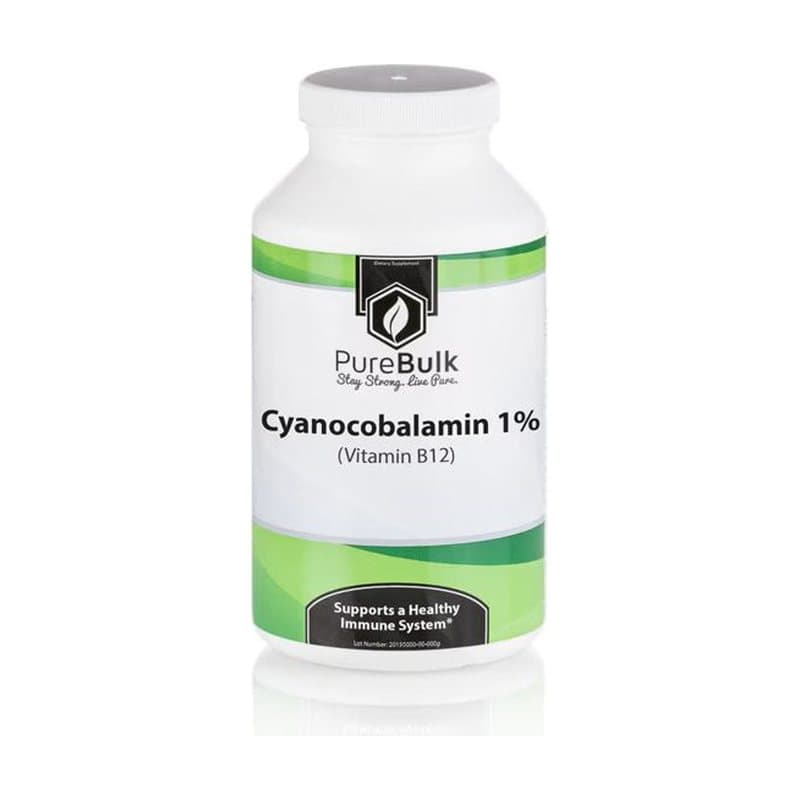
| PureBulk Cyanocobalamin 1% (Mannitol 99%) (Vitamin B12) · 300ct 2000mcg Gel. Caps. | PureBulk | $0.043 | 73% less |
| Piping Rock B-12 · 1000 mcg · 220 Tablets | Piping Rock | $0.045 | 72% less |
| Carlson Vitamin B-12 · 180 Tablets | Carlson | $0.12 | 25% less |
| Nature Made Vitamin B12 1000 mcg Softgels · 150 softgels popular brand | Nature Made | $0.16 | — |
Prices checked November 25, 2026. Store prices change; the price at checkout is final. See the full vitamin b12 list
Methylcobalamin:
| Product | Store | Per 1,000 mcg |
|---|---|---|
| Micro Ingredients Vitamin B12 1,000mcg · 365 Chewable Tablets | Micro Ingredients | $0.055 |
| Nutricost Vitamin B12 Capsules · 1000 MCG · 240 Caps | Nutricost | $0.067 |
| MegaFood Extra Strength Methyl B12 · 90 ct · 90 days | MegaFood | $0.093 |
| NutraBio Vitamin B-12 · 90 Servings | NutraBio | $0.094 |
Prices checked November 25, 2026. Store prices change; the price at checkout is final. See the full vitamin b12 list
In our November 14, 2026 price check, the cheapest cyanocobalamin cost less per 1,000 mcg than the cheapest methylcobalamin, but the ranges overlap: some methyl products cost less than some brand-name cyanocobalamin. Price per 1,000 mcg is a unit for comparing, not a dose recommendation. See how it works.
How to compare B12 labels
- Check the form. The supplement facts panel names it, often in parentheses: "Vitamin B12 (as cyanocobalamin)". See how to read a supplement facts label.
- Check the strength per tablet. A 2,000 mcg capsule is not comparable at the shelf price to a 1,000 mcg one. Divide the price by total micrograms in the bottle.
- Watch for blends. B-complex products and B12 with folate are different products and are left off our list.
- Look for a third-party seal if you want an outside check that the label is accurate. See what third-party tested means.
For more low-cost basics priced the same way, see best value supplements of 2026.
Frequently asked questions
Is methylcobalamin better than cyanocobalamin?
The NIH says research has not shown any form of supplemental B12 to be better than the others. A 2015 review concluded methylcobalamin is unlikely to be an advantage over cyanocobalamin.
Is the cyanide in cyanocobalamin dangerous?
Cyanocobalamin is the most common form in supplements and fortified foods, and the NIH says B12 has not been shown to cause harm, even at high doses. A 2015 review called it a stable form well suited to oral supplements.
How much of a 1,000 mcg B12 tablet is absorbed?
About 1.3%, according to the NIH, or roughly 13 mcg. That is still more than the adult RDA of 2.4 mcg.
Which form of B12 is cheaper?
Cyanocobalamin usually is. In our November 2026 price check, the cheapest cyanocobalamin cost less per 1,000 mcg than the cheapest methylcobalamin, though the price ranges overlap.
Should vegans take B12?
The NIH says only animal foods contain B12 naturally, and that fortified foods and supplements can substantially reduce the risk of deficiency in vegetarians and vegans. Either form works.
Sources
- NIH Office of Dietary Supplements: Vitamin B12 fact sheet for health professionals (opens in a new tab)
- NIH Office of Dietary Supplements: Vitamin B12 fact sheet for consumers (opens in a new tab)
- Cobalamin coenzyme forms are not likely to be superior to cyano- and hydroxyl-cobalamin in prevention or treatment of cobalamin deficiency (Obeid, Fedosov and Nexo, 2015) (opens in a new tab)
Every price on the list is worked out the same way, and checked daily.
See the vitamin B12 price comparisonCheaper alternatives to Nature Made vitamin B12Nature Made vs PureBulk vitamin B12
This is general information about prices and labels, not medical advice. Ask a doctor or pharmacist before starting a supplement, especially if you are pregnant, take medication, or have a health condition. These statements have not been evaluated by the Food and Drug Administration, and no supplement here is intended to diagnose, treat, cure, or prevent any disease. We don't sell the products; how we make money.