Fish oil guide
How much EPA and DHA per day? Doses and what they cost
The EPA + DHA amounts behind common advice, what the VITAL, REDUCE-IT and STRENGTH trials used, the atrial fibrillation signal, and what a daily dose costs.
"How much fish oil should I take?" is really a question about EPA and DHA, the two omega-3s the research is about. The number on the front of the bottle is usually the weight of the oil. The dose is on the back.
The numbers people use
| Context | EPA + DHA per day |
|---|---|
| General health (about 8 oz of seafood a week) | about 250 to 300 mg |
| AHA advice for people with coronary heart disease | about 1 g |
| Prescription treatment for high triglycerides | 4 g |
| FDA: considered safe from supplements | up to 5 g |
Rounded figures from the sources below.
Where those come from:
- The 2015 to 2020 Dietary Guidelines for Americans advised about 8 ounces of a variety of seafood a week, which works out to roughly 250 mg of EPA + DHA a day. The European Food Safety Authority uses 250 mg a day, and the UN's Food and Agriculture Organization 300 mg.
- The US has no RDA for EPA or DHA. The adequate intake set by the National Academy of Medicine is for ALA, the plant omega-3.
- The FDA has concluded that supplements providing no more than 5 g a day of EPA + DHA are safe when used as recommended. That is a safety ceiling, not a target.
What the big trials found
- VITAL gave 25,871 US adults without heart disease or cancer 1 g a day of fish oil (460 mg EPA + 380 mg DHA) or placebo for a median of 5.3 years. It did not lower the rate of major cardiovascular events or cancer, its main outcomes. Heart attacks, a secondary outcome, were 28% lower in the fish oil group.
- REDUCE-IT gave 8,179 people 4 g a day of icosapent ethyl, a prescription purified-EPA drug, or a mineral oil placebo. Everyone had heart disease, or diabetes plus another risk factor, and elevated triglycerides despite a statin. Cardiovascular events were lower with the drug.
- STRENGTH gave 13,078 high-risk people 4 g a day of a different prescription omega-3 (EPA + DHA) or corn oil. It found no reduction in cardiovascular events and was stopped early.
Nobody is sure why REDUCE-IT and STRENGTH disagree. The drug, the patients and the placebo oils all differed.
The takeaway: over-the-counter fish oil at ordinary doses has not been shown to prevent heart attacks and strokes in people without heart disease. In its 2017 advisory, the American Heart Association said no recommendation could be made for supplements in the general population. High-dose prescription omega-3 is a separate, doctor-managed treatment.
The atrial fibrillation signal
A 2021 meta-analysis in Circulation pooled 7 large trials with 81,210 people. Omega-3 supplements were linked to a 25% higher risk of atrial fibrillation, an irregular heart rhythm. The increase was larger in trials using more than 1 g a day (49% higher) than in trials using 1 g a day or less (12% higher).
These were mostly older people with or at risk of heart disease, so the numbers don't map neatly onto a healthy 30-year-old. Still, it is a reason not to self-prescribe high doses, especially with a history of heart rhythm problems.
Turning a dose into softgels
Read EPA and DHA on the back of the bottle and add them. Check how many softgels make one serving.
- A typical 1,000 mg fish oil softgel has about 180 mg EPA and 120 mg DHA, so 300 mg. One a day covers the general-health target.
- A concentrated softgel might list, for example, 650 mg EPA and 450 mg DHA, or 1,100 mg. One of those is already above 1 g.
More in 1,000 mg fish oil is not 1,000 mg omega-3.
What a daily dose costs
Our fish oil price comparison prices every bottle per 1 g of EPA + DHA. To get your daily cost, scale it to your dose: 250 mg a day costs a quarter of the listed price, 500 mg costs half.
| Product | Store | Per 1 g EPA+DHA | vs Nature Made |
|---|---|---|---|
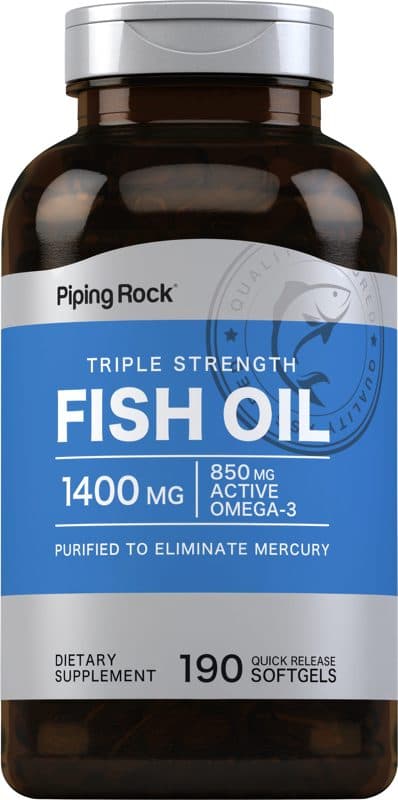
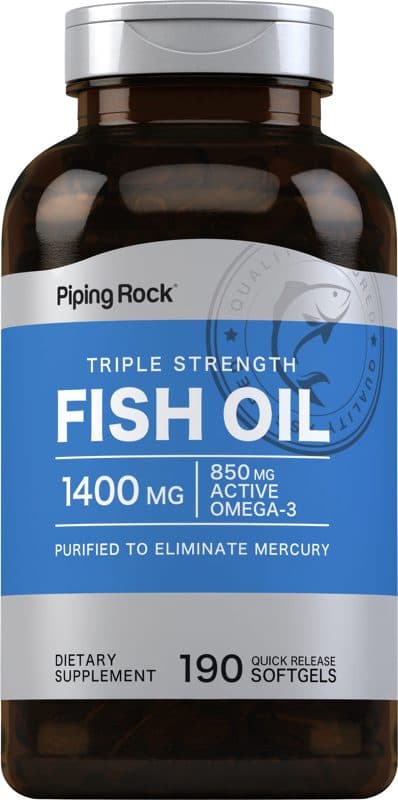
| Piping Rock Triple Strength Omega-3 Fish Oil 1400 mg (850 mg Active Omega-3) · 190 Quick Release Softgels | Piping Rock | $0.15 | 62% less |
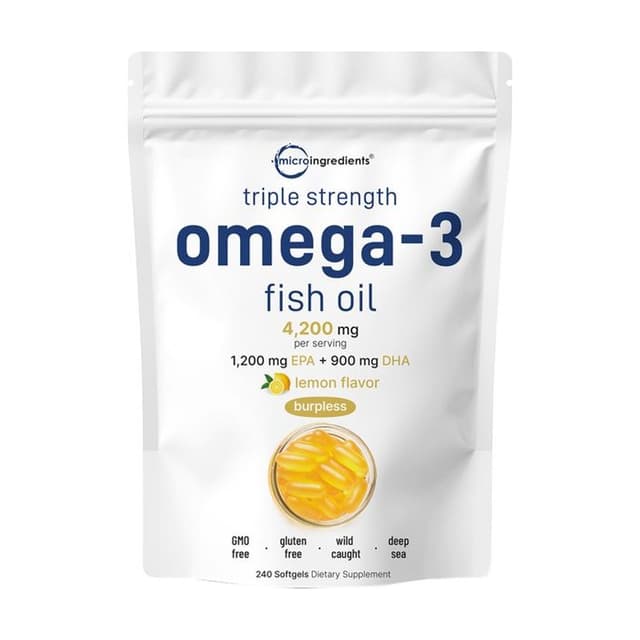
| Micro Ingredients Triple Strength Omega 3 Fish Oil Supplements 4200mg Per Serving · 240-Softgel | Micro Ingredients | $0.21 | 46% less |
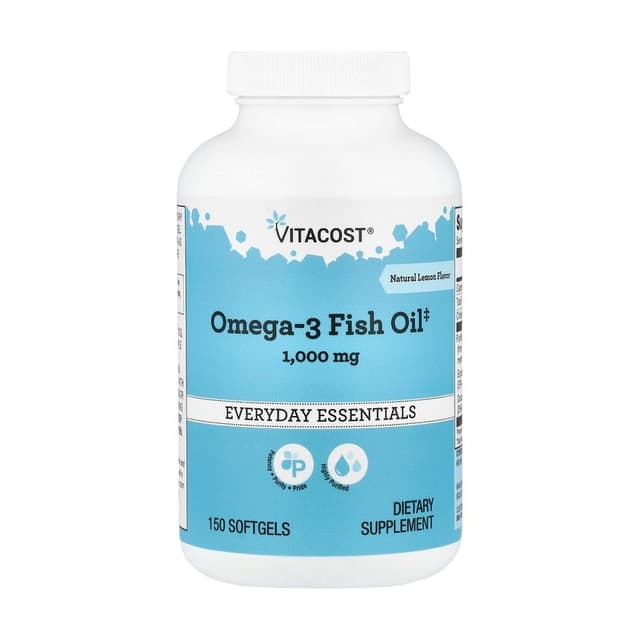
| Vitacost Everyday Essentials, Omega-3 Fish Oil, Natural Lemon · 1,000 mg · 150 Softgels | Vitacost | $0.21 | 46% less |
| Nature Made Fish Oil 1000 mg Softgels · 250 softgels popular brand | Nature Made | $0.39 | — |
Prices checked November 7, 2026. Store prices change; the price at checkout is final. See the full fish oil list
For ranked picks, see best fish oil in 2026.
If you don't eat fish
Algae oil provides DHA, and some products add EPA, without fish. It usually costs more per gram. See algae oil vs fish oil.
Who should ask a doctor first
- Anyone thinking about more than 1 g a day of EPA + DHA.
- People with a history of atrial fibrillation or other heart rhythm problems.
- People taking warfarin or other blood thinners. Fish oil can have antiplatelet effects at high doses, and the NIH notes it might prolong clotting times with warfarin.
- People with a fish or shellfish allergy.
- Anyone pregnant, where DHA advice differs and seafood choice matters for mercury.
The most common side effects are mild: fishy taste, heartburn, nausea and loose stools.
Frequently asked questions
How much EPA and DHA should I take a day?
For general health, about 250 mg a day is the common target, roughly what 8 ounces of seafood a week provides. Higher doses are for specific conditions under medical care.
Is 1,000 mg of fish oil enough?
It depends on the EPA + DHA inside. A typical 1,000 mg softgel has about 300 mg, which covers the general-health target.
Is it safe to take 3 or 4 grams of fish oil a day?
The FDA considers up to 5 g a day of EPA + DHA from supplements safe, but trials linked doses above 1 g a day with a higher risk of atrial fibrillation. Doses that high should be a doctor's call.
Does fish oil prevent heart attacks?
In people without heart disease, the large VITAL trial found 1 g a day did not lower major cardiovascular events overall, though heart attacks were lower as a secondary outcome. The American Heart Association makes no recommendation for supplements in the general population.
Sources
- NIH Office of Dietary Supplements: Omega-3 fatty acids fact sheet (opens in a new tab)
- Dietary intakes of EPA and DHA, with US and international recommendations (Zhang et al., Nutrients, 2018) (opens in a new tab)
- VITAL: Marine n-3 fatty acids and prevention of cardiovascular disease and cancer (Manson et al., NEJM, 2019) (opens in a new tab)
- STRENGTH: High-dose omega-3 fatty acids vs corn oil (Nicholls et al., JAMA, 2020) (opens in a new tab)
- Omega-3 supplementation and atrial fibrillation risk: meta-analysis (Gencer et al., Circulation, 2021) (opens in a new tab)
- AHA science advisory: omega-3 supplementation and cardiovascular disease (Siscovick et al., 2017) (opens in a new tab)
Every price on the list is worked out the same way, and checked daily.
See the fish oil price comparisonCheaper alternatives to Nature Made fish oilCheaper alternatives to Nordic Naturals fish oilCheaper alternatives to Sports Research fish oilNature Made vs Piping Rock fish oilNordic Naturals vs Piping Rock fish oilSports Research vs Piping Rock fish oilNordic Naturals vs NOW Foods fish oil
This is general information about prices and labels, not medical advice. Ask a doctor or pharmacist before starting a supplement, especially if you are pregnant, take medication, or have a health condition. These statements have not been evaluated by the Food and Drug Administration, and no supplement here is intended to diagnose, treat, cure, or prevent any disease. We don't sell the products; how we make money.